
- Home
- About Us
-
SIW Product / Service
- SIW Product / Service
- Product
- Service
- Certification / Standard
- Sustainability
- News
- Work With Us
- Contact Us
-
Font Size
- S
- M
- L
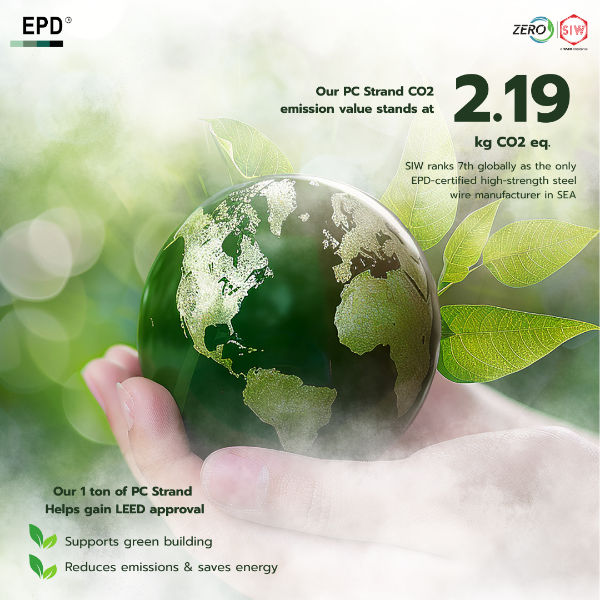

SIW ranks 7th globally and is the only EPD-certified high-strength steel wire manufacturer in Southeast Asia. With a carbon emission value of only 2.19 kg CO₂ eq. per unit of PC Strand
SIW supports green building, reduces carbon emissions, and saves energy —
a step forward toward a more sustainable future.
28-04-2026
⚠️ Clearing Up the ConfusionWhat’s the difference between Cold Drawn Wire VS Reinforcing Bar (Rebar) ? Here’s a simple breakdown you can understand in under 3 minutes:Cold Drawn WireCold Drawn Wire is produced by drawing steel through a die at room temperature, where the strength increases due to the strain hardening process. As a result, it offers precise dimensions and a smooth, shiny wire surface, making it suitable for applications such as:✔ Concrete Pipes✔ Stirrups✔ Spun Piles✔ Precast ConcreteReinforcing Bar (Rebar)Reinforcing Bar (Rebar) is manufactured by rolling steel with rollers at high temperatures (900–1200°C), allowing the metal to be easily shaped without cracking. However, its dimensional accuracy is lower compared to cold-drawn wire, and oxide scale forms on the surface, which must be removed after hot rolling. It is commonly used in applications such as:✔ Columns✔ Beams✔ Slabs📌 Quick SummaryIf the application focuses on strength, choose Cold Drawn Wire.If the application focuses on bonding with concrete and ductility, choose Reinforcing Bar (Rebar). Click >>HERE<< to see more about our Cold Drawn Wire.
26-12-2024
Stepping Towards a Sustainable Future with Electric Vehicles To support our ESG goals, SIW has transitioned to using electric vehicles within the factory, including Electric Trucks and Electric Forklifts. This initiative is part of our commitment to reducing environmental impact and building a sustainable future.
08-06-2022
พื้น Post Tension โดยทั่วไป คือระบบพื้นคอนกรีตที่มีเหล็กเส้นที่รับแรงดึงได้มาก ๆ เสริมอยู่ภายใน และทำการดึงเส้น เหล็กนั้นให้ตึงเมื่อหล่อคอนกรีตเสร็จแล้ว เพื่อเพิ่มความเข้มแข็งของพื้น การที่มีเหล็กแรงดึงดูดเสริมและดึงอยู่ในพื้นคอนกรีตนี่เอง ทำให้โครงสร้างชนิดนี้มีหน้าตัดที่บางลง และไม่จำเป็นต้องมีคานมารับหัวเสาเพื่อการถ่ายน้ำหนัก จากพื้นสู่เสาด้วย ราคาค่าก่อสร้างหลายอาคารก็ถูกลง และยังลดความสูงระหว่างชั้นได้ด้วย พื้นระบบ Post Tension คือพื้นคอนกรีตเสริมเหล็กอัดแรง เพื่อให้โครงสร้างสามารถรับแรงได้มากกว่าปกติ จนทำให้โครงสร้าง พื้นเห็นเป็นเพียงแผ่นคอนกรีตบาง ๆ (20-28 ซม.) ไม่มีคานมารับตามช่วงเสา ทำให้พื้นระบบ Post Tension (สะดวกกว่าระบบมีคาน) และลดค่าใช้จ่ายในงานโครงสร้างได้ พอสมควรทีเดียว เนื่องจากพื้น Post-Tension เป็นระบบพื้นซึ่งดึงลวดอัดแรง จึงจำเป็นต้องร้อยลวดอัดแรงไว้ในท่อ Galvanized เพื่อไม่ให้คอนกรีตจับตัวกับลวดอัดแรง สามารถแบ่งออกเป็น 2 ระบบ ที่มีลักษณะต่างกันดังนี้ 1. Bonded System เป็นระบบมีแรงยึดแหนี่ยว ระหว่าง PC Strand กับพื้นคอนกรีตโดยหุ้มด้วยท่อเหล็กที่ขึ้นเป็นลอน เพื่อช่วยในเรื่องของแรงยึดเหนี่ยว ภายหลังเมื่อทำการอัดน้ำปูนเข้าไปให้เต็มท่อหลังการดึงลวด (GROUTING) เพื่อให้จับยึดระหว่าง PC Strand กับท่อเหล็ก จะใช้กับอาคารที่พักอาศัย ห้างสรรพสินค้า สำนักงาน และโครงสร้างขนาดใหญ่ 2. UnBonded System เป็นระบบไม่มีแรงยึดแหนี่ยว ระหว่าง PC Strand กับพื้นคอนกรีต แต่จะยึดที่บริเวณหัว Anchorage ที่ปลายพื้นทั้ง 2 ข้างเท่านั้น โดยใช้ ( PE unbounded PC strand )เป็นตัวยึดเหนี่ยว ระบบนี้ไม่เหมาะสำหรับอาคารที่จะมีการเปลี่ยนแปลงวัตถุประสงค์การใช้ งานในอนาคต แต่จะนิยมใช้กับระบบพื้นที่เป็น อาคารที่จอดรถ หรืออาคารขนาดเล็กที่มักจะไม่มีการเปลี่ยนแปลงการใช้งานที่ตามมาในอนาคต ข้อดีของ ระบบพื้นพื้น Post Tension รวดเร็วกว่า: สามารถก่อสร้างได้อย่างรวดเร็วเมื่อเทียบกับระบบพื้นโครงสร้างเสริมเหล็กทั่วไป คุ้มค่ากว่า : ออกแบบโดยคำนึงถึงความประหยัดของโครงสร้างและค่าก่อสร้างโดยรวม อาทิเช่นแรงงาน ไม้แบบ คอนกรีต เป็นต้น
02-09-2025
We can’t control the weather, but we can plan ahead.Don’t let rain slow you down, use these simple techniques to keep your project on track, protect your materials, and avoid costly delays.1. Check the Weather DailyMonitor forecasts every morning to adjust your work schedule accordingly. 2. Drain Standing Water DailyNever leave water to pool at the site. It can weaken soil conditions and threaten the stability of the foundation and structure.3. Start with Indoor Work FirstPrioritize indoor or covered tasks first. This allows construction work to continue with minimal disruption, even during periods of rain.4. Protect Materials and EquipmentStore cement, steel, wood, and electrical tools in dry areas or cover them with waterproof tarps to avoid damage and reduce replacement costs.5. Set Up Temporary Drainage SystemsUse temporary drainage systems like trenches or PVC pipes to quickly redirect rainwater and keep the site safe and operational.💡 Small steps like these can save time, reduce costs, and maintain construction quality—even during the rainy season.Plan smart. Store safely. Prevent damage before it happens.#ConstructionTips #RainySeasonReady #SiteManagement #ProjectPlanning #BuildSmart
15-01-2025
Gen Y leadership shaping the future of organizations Naphitset Chainapong, Head of Section-Demand and Market Planning, who plays a key role in driving organizational success. “Growing up in the middle of Gen Y, I’ve witnessed the rapid evolution of technology, transitioning from the analog era to the fully digital age we live in today. This experience has shaped my mindset and serves as a fundamental basis for how I approach my work to this day. In my perspective, the transition to digital is no longer an option but a necessity. I clearly remember when I started working at SIW, we relied heavily on paper documents, and at times, the piles of paperwork were almost impossible to manage. But today, we’ve seen a significant difference. Many documents no longer need to be printed, and they have been fully integrated into a digital system. Additionally, we now use various software tools to analyze statistical data, helping us identify market demands and study consumer behavior quickly and more accurately. The result is more precise decision-making, allowing us to better meet our customers’ needs. Another equally important and trending topic is sustainability. In my perspective, it’s not just a fancy phrase but a global responsibility that every organization should prioritize. SIW has continuously developed sustainability strategies, such as controlling carbon emissions, initiating the "1 Rai Farm" project, and organizing CSR activities that foster collaboration with local communities. We’ve always believed that growth must come with a sense of responsibility toward both our communities and the world. As a Gen Y, I believe SIW benefits from the generation gap, gaining fresh ideas from younger team members and valuable experience from senior colleagues. An organization’s success doesn’t depend on one individual but comes from the synergy of all generations working together to innovate while preserving the past and continuing to develop sustainably. And finally, I believe that working in this rapidly changing era requires flexibility, open-mindedness, and collaboration from everyone. With our collective dedication, I am confident that SIW will overcome every challenge and continue to grow steadily in an ever-changing world.”
16-12-2024
Construction Trends to Watch in 2025 Modern construction trends focus not only on developing advanced and robust structures but also on integrating clean and alternative energy sources to promote sustainability and reduce environmental impacts. These trends mark a significant step toward a sustainable future. Sustainable Construction The concept of sustainable construction is gaining significant traction in the construction industry as it aligns with ESG principles, emphasizing environmental impact reduction and efficient resource use. Examples include: Utilizing environmentally friendly construction materials. Implementing carbon-reduction techniques in construction processes. Managing waste effectively by sorting and recycling materials. This approach not only mitigates environmental impacts but also enhances resource efficiency, ensuring that modern structures meet current needs without depleting future resources. Digital Technology in Construction Digital technologies are transforming workflows in the construction industry, making them more efficient and sustainable. Examples include: IoT (Internet of Things): Real-time data collection devices for monitoring safety on construction sites. AI (Artificial Intelligence): Data analysis tools to optimize processes, such as safety risk assessments. BIM (Building Information Modeling): Enables precise structural designs and project management, minimizing material waste and construction errors. Other advanced technologies, such as drones for 3D site surveys and AR/VR for virtual design, reduce costs, improve safety, and facilitate accurate decision-making. Clean Energy The adoption of clean energy in construction is accelerating, particularly in large-scale projects aiming to minimize environmental impacts. Examples include: Solar Roofs: Lower energy costs and reduce greenhouse gas emissions. Wind Energy: Harnessing wind power to decrease reliance on fossil fuel-based electricity. Using clean energy not only lessens environmental impacts but also reduces energy costs, creating sustainable structures to meet future needs efficiently. Prefabrication Prefabricated construction is another key trend. This involves designing and manufacturing components such as pre-made walls, floor panels, columns, and roofs in controlled factory environments before assembling them on-site. Prefabrication speeds up construction, reduces site complexities, and ensures quality. SIW’s Commitment to Construction Trends SIW prioritizes key construction trends, such as employing AI to enhance operational efficiency, utilizing clean energy like solar power, and supporting sustainable construction through recycled materials from EAF (Electric Arc Furnace) technology. SIW has also achieved Green Industry Level 4 certification and is working towards its Net Zero carbon emission goal by 2050, advancing sustainability in all dimensions of the construction industry.
30-05-2023
ในการก่อสร้างอาคารในปัจจุบัน เราสามารถเห็นการใช้งานตะแกรงเหล็กไวร์เมช มาทดแทนการใช้เหล็กเส้นในส่วนของเหล็กเสริมล่าง ได้มากขึ้นเรื่อยๆ เช่น พื้นโรงงาน , พื้น Post-tension และถนนคอนกรีต เป็นต้นฯ เนื่องจากตะแกรงเหล็กไวร์เมช สามารถประหยัดเวลาและต้นทุนได้มากกว่าเป็นไหนๆ แต่ในการหันมาใช้ตะแกรงเหล็กไวร์เมช แทนเหล็กผูกก็อาจมีวิธีการใช้งานและหลักการคำนวณบางอย่างที่แตกต่างกัน หนึ่งในเรื่องที่หลายคนสงสัยมากคือ “การต่อทาบตะแกรงเหล็กไวร์เมช” ควรมีระยะเท่าไหร่จึงจะเหมาะสมและไม่ก่อให้เกิดปัญหาในภายหลัง การต่อทาบตะแกรงเหล็กไวร์เมช ตะแกรงเหล็กที่ใช้เป็นเหล็กเสริมในแผ่นพื้น จะต้องมีการต่อทาบ ดังนี้ 1. ควรหลีกเลี่ยงการต่อลวดโดยใช้วิธีทาบ ณ บริเวณที่มีหน่วยแรงสูงสุด (ตำแหน่งที่ลวดพื้นรับแรงเกินกว่าครึ่งของหน่วยแรงที่ยอมให้) แต่ถ้าจำเป็นจะต้องใช้การต่อวิธีนี้ ต้องมีระยะทาบของตะแกรงไม่น้อยกว่าระยะเรียงของเส้นลวดบวกเพิ่มอีก 5 เซนติเมตร 2. การต่อลวดตะแกรงที่รับแรงไม่เกินครึ่งหนึ่งของหน่วยแรงที่ยอมให้จะต้องมีระยะทาบไม่น้อยกว่า 5 เซนติเมตร อ้างอิง: มาตรฐานสำหรับอาคารคอนกรีตเสริมเหล็กโดยวิธีหน่วยแรงใช้งาน (วสท. 011007-19) และทางสยามลวดเหล็กฯ ก็มีตะแกรงเหล็ก ไวร์เมช ที่ผ่านมาตรฐาน มอก. 737 ตอบโจทย์เรื่องคุณภาพ, ความปลอดภัย, รวดเร็ว และยังมีบริการการออกแบบ CAD, การจัดสรรงบประมาณ, แถมมีวิศวกรให้คำปรึกษาฟรี!! ดูรายละเอียดสินค้าเพิ่มเติม: https://www.siw.co.th/th/product-detail/wire-mesh

We are relentless in our pursuit for excellence in product quality and innovation. We take pride in being able to anticipate your needs and provide tailored solutions for each of your requirements. We strive to exceed expectations.